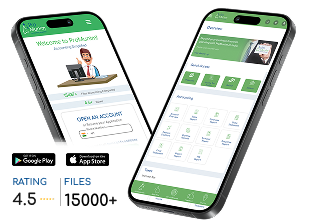
For businesses in Andrott:
ProMunim provides smart business support for accounting,
CRM, GST billing, compliance, reporting and digital business management.
Businesses, startups, MSMEs and professionals in Andrott can use ProMunim to simplify daily business operations, improve financial tracking, manage customers, automate billing and stay compliant with Indian business requirements.
GST Registration Online Guide for Startups & MSMEs by Promunim of India
Launching a new venture in India brings excitement, ambition, and a long list of regulatory tasks. Completing your GST registration online is one of the most important legal milestones for any startup or micro, small, and medium enterprise (MSME). Without a valid Goods and Services Tax Identification Number (GSTIN), your business cannot legally collect tax from customers or claim input tax credits on purchases.
Navigating the government portal alone often feels overwhelming for first-time founders. Missing a single document or selecting the wrong business constitution can trigger departmental notices and weeks of approval delays. That is why many entrepreneurs partner with ProMunim of India to simplify compliance right from day one.
In this guide, you will learn the exact eligibility rules, required paperwork, portal steps, and expert tips to secure your GSTIN without unnecessary friction.
What Is GST Registration Online and Who Needs It?
GST registration online is the digital process through which a business registers itself under India’s Goods and Services Tax Act via the official Goods and Services Tax Network (GSTN) portal. Once approved, the tax department issues a unique 15-digit GSTIN linked to your business Permanent Account Number (PAN).
While small local vendors below certain revenue limits can operate without registering, Indian tax law mandates registration for several business categories regardless of their annual turnover.
Compulsory Registration Regardless of Turnover
Even if your startup earned zero revenue last month, you must apply for a GSTIN if you fall into any of these categories:
- Inter-State Suppliers: You sell goods to customers located in a different Indian state.
- E-Commerce Sellers: You list and sell products through marketplaces like Amazon, Flipkart, Meesho, or your own direct-to-consumer store operating as an e-commerce operator.
- Casual Taxable Persons: You supply goods or services occasionally at exhibitions, trade fairs, or pop-up events in a state where you lack a fixed place of business.
- Reverse Charge Liability: Your business is required to pay tax under the Reverse Charge Mechanism (RCM) on specific notified goods or legal and transport services.
- Input Service Distributors and Agents: You distribute input tax credits across branches or act as an agent supplying goods on behalf of another taxable person.
Why Obtaining a GSTIN Matters for Growing Businesses
Many founders treat tax registration as a burden to postpone until the last minute. In reality, securing a professional GST registration service early unlocks major commercial advantages that help startups scale faster.
1. Seamless Input Tax Credit (ITC) Claims
Every startup spends money on laptops, office furniture, software subscriptions, marketing agencies, and raw materials. When you hold a valid GSTIN, you can offset the GST paid on these business purchases against the GST you collect from clients. Unregistered businesses absorb that 18% tax as a permanent sunk cost.
2. Eligibility for B2B Contracts and Enterprise Clients
Large corporations, government departments, and established enterprises rarely onboard unregistered vendors. Because corporate buyers want to claim Input Tax Credit on vendor invoices, holding a GSTIN immediately makes your startup eligible for high-value B2B contracts.
3. Nationwide Expansion Without Borders
A GSTIN empowers you to ship products across state borders and on-board onto major online marketplaces legally. You can also open additional places of business or warehouses in other states as your customer base expands.
4. Stronger Business Credibility and Banking Access
Banks, NBFCs, and angel investors view GST compliance as proof of a legitimate, transparent enterprise. Your GST certificate acts as recognized identity proof when opening a current bank account or applying for working capital loans.
Complete Checklist of Documents Required for GST Registration
Preparing the documents required for GST registration beforehand prevents portal timeouts and clarification notices from tax officers. Keep clear, legible digital scans (PDF or JPEG format under 1 MB) ready before starting your application.
Documents requirement:
- Proof of Business Registration: For Proprietorship: Any document establishing the proprietorship, such as proprietorship registration certificate or PAN card. For Partnership Firm: Partnership deed. For Company: Certificate of Incorporation, Memorandum and Articles of Association. For LLP (Limited Liability Partnership): Certificate of Incorporation, LLP Agreement. For Trust/Society: Registration Certificate.
- Proof of Constitution of Business: Partnership deed (if applicable). Memorandum and Articles of Association (for companies). Certificate of Incorporation (for companies and LLPs). Trust Deed (for trusts). Society Registration Certificate (for societies).
- PAN Card of the Business: Permanent Account Number (PAN) card of the business entity.
- Identity and Address Proof of Promoters/Partners/Proprietor: Aadhaar card, passport, voter ID, or driving license. Proof of address such as Aadhaar card, passport, voter ID, or driving license.
- Proof of Principal Place of Business: Ownership documents, such as property tax receipt or electricity bill. Rental/Lease agreement along with landlord's identity proof, if the property is rented. Consent letter from the landlord.
- Bank Account Details: Scanned copy of cancelled cheque or bank statement. Bank account number, IFSC code, and branch details.
- Authorized Signatory Details: Photographs and identity proof (Aadhaar card, passport, voter ID, or driving license) of authorized signatory.
- Digital Signature Certificate (DSC) of Authorized Signatory (if applicable): In case of companies, LLPs, and foreign entities, a DSC is required for online GST registration.
- Business Registration Proof under Previous Law (if applicable): VAT registration certificate. Service tax registration certificate. Excise registration certificate.
- Additional Documents (if applicable): NOC from the landlord if the principal place of business is rented. Board resolution authorizing a person to sign the GST application (for companies).
Regular Scheme vs. Composition Scheme vs. CA-Assisted Filing
Choosing the right registration category and filing approach shapes your cash flow and monthly workload. Use the comparison table below to decide which structure fits your business model best.
| Feature / Criteria | Regular GST Scheme | Composition GST Scheme | CA-Assisted Registration & Filing |
| Input Tax Credit (ITC) | Yes - Full ITC allowed on eligible business purchases | No - Cannot claim ITC on inward supplies | Maximizes eligible ITC through monthly reconciliation |
| Inter-State Sales | Allowed nationwide across all states | Not Allowed (only intra-state sales permitted) | Manages multi-state GSTINs and IGST compliance |
| E-Commerce Selling | Allowed on all marketplaces | Restricted (allowed only for intra-state goods under specific conditions) | Full marketplace reconciliation and TCS matching |
| Return Filing Frequency | Monthly or Quarterly (GSTR-1, GSTR-3B) + Annual Return | Quarterly challan (CMP-08) + Annual Return (GSTR-4) | End-to-end automated calendar and zero-delay filing |
| Best Suited For | B2B startups, manufacturers, agencies, e-commerce sellers | Small local retailers, grocery stores, standalone restaurants | Busy founders seeking error-free compliance and audit safety |
Once your GSTIN is active, staying consistent with GST filing for small business operations is mandatory even during months with zero sales, where a "Nil Return" must still be submitted to avoid daily late fees.
6 Common Mistakes That Delay GST Approval (And How to Avoid Them)
Over 30% of first-time DIY applications face rejection or show-cause queries due to avoidable clerical errors. Watch out for these six pitfalls:
- Mismatched Name Between PAN and Application: Entering your brand's marketing name instead of the exact legal name registered on the Income Tax database causes immediate validation failure. Always put your legal name in the "Legal Name" box and your brand name under "Trade Name."
- Blurry or Expired Utility Bills: Uploading an electricity bill older than two months or a cropped scan where the consumer number and address are unreadable almost always triggers a Form REG-03 query.
- Missing Landlord Consent on Rented Offices: Submitting a rent agreement alone without the owner's latest electricity bill or tax receipt leads to rejection. Always attach both the agreement and the owner's ownership proof.
- Selecting Wrong HSN/SAC Codes: Picking generic or inaccurate service codes can create invoice mismatches later when corporate clients process your bills.
- Forgetting to Add Bank Details Within 45 Days: New startups sometimes apply before opening a current account. Remember to file a non-core GST registration amendment within 45 days of grant of registration, or the department can suspend your GSTIN automatically.
- Ignoring the 7-Day Clarification Window: Tax officers give strictly 7 working days to reply to queries. Missing that deadline cancels your ARN, forcing you to restart the entire process from scratch.
Why Choose ProMunim of India for Hassle-Free GST Compliance?
Registering your business is only the first step; maintaining clean books, reconciling vendor invoices, and filing monthly returns require ongoing expertise. Partnering with an experienced GST registration service provider ensures you never lose sleep over tax notices or missed deadlines.
ProMunim of India combines certified Chartered Accountant oversight with modern digital accounting tools tailored specifically for Indian startups and MSMEs:
- End-to-End Application Handling: From verifying your property NOC and selecting exact HSN/SAC codes to tracking your ARN and replying to officer queries, ProMunim of India’s specialists manage your entire GST registration online workflow.
- Dedicated Accountant Starting at ₹65/Day: Beyond initial registration, you can hire a dedicated accountant to handle daily bookkeeping, GSTR-1/GSTR-3B filings, and ITC reconciliation at a fraction of an in-house salary.
- Proven Track Record Across India: Accredited by the Ministry of Commerce, ProMunim of India holds a 4.6-star client rating and has successfully accounted for 15,000+ business files.
- Hybrid Digital + Local Branch Support: Manage invoices, track tax calendars, and download reports anytime through the secure Client Web Portal, or walk into any local branch offices for face-to-face guidance.
- Flexible, Startup-Friendly Payments: Preserve your early working capital with transparent pricing and convenient payment options, including NACH and Bajaj Easy EMI plans.
Conclusion: Start Your Business Compliance on the Right Foot
Completing your GST registration online unlocks Input Tax Credits, builds instant trust with B2B clients, and keeps your startup protected from tax penalties. By organizing your PAN, Aadhaar, entity proofs, and address documents carefully and choosing the right tax scheme from the start you lay a solid financial foundation for long-term growth.
Instead of risking rejections or wasting valuable founder hours decoding tax rules, let seasoned professionals handle your paperwork smoothly. Ready to get your GSTIN fast and keep your monthly accounting effortless? Contact with Promunim of India today and let our tax experts take care of your compliance while you focus on scaling your business.
Frequently Asked Questions
1. How many days does GST registration online take in India?
When all documents are accurate and Aadhaar authentication is completed online, GST registration typically takes 3 to 7 working days. If the tax officer requests clarification or physical premises verification, approval can take up to 15 to 30 days.
2. Can I apply for GST registration using my residential address?
Yes, freelancers, service startups, and home-based e-commerce sellers can register using a residential address. You simply need to upload a recent electricity bill or property tax receipt, along with a signed No Objection Certificate (NOC) if the home is owned by a spouse or parent.
3. Is a current bank account mandatory at the time of applying for GST?
No, you can submit your GST registration application without a current bank account. However, once your GSTIN is approved, you must open a current account in your business name and update the details on the GST portal within 45 days (or before filing your first return, whichever is earlier).
4. What happens if I cross the turnover limit and fail to register for GST?
Operating without registration after crossing the mandatory threshold attracts heavy penalties under Section 122 of the CGST Act. You face a penalty of 100% of the tax due or ₹10,000, whichever is higher, plus accrued interest on unpaid taxes and loss of Input Tax Credit.
5. Can I cancel or amend my GST registration later if my business changes?
Yes, you can update business details like your office address, partners, or mobile number anytime by filing Form GST REG-14 online. If you close your business or fall below exemption limits, you can apply for voluntary cancellation through Form GST REG-16 after clearing all pending returns.