For businesses in Jaipur:
ProMunim provides smart business support for accounting,
CRM, GST billing, compliance, reporting and digital business management.
Businesses, startups, MSMEs and professionals in Jaipur can use ProMunim to simplify daily business operations, improve financial tracking, manage customers, automate billing and stay compliant with Indian business requirements.
Sole Proprietorship Registration: Complete Guide for Small Businesses
Introduction
Starting a business in India does not always require a complicated legal structure. For freelancers, traders, consultants, shop owners, service providers, and small business entrepreneurs, a sole proprietorship is one of the simplest and most cost-effective ways to begin a business journey.
A sole proprietorship is owned and managed by a single individual who enjoys complete control over business operations, profits, and decision-making. Due to its easy setup process, minimal compliance requirements, and low registration costs, it remains one of the most preferred business structures in India.
In this comprehensive guide, we will explain everything you need to know about Sole Proprietorship Registration in India, including eligibility, benefits, registration process, required documents, taxation, and compliance requirements.
What is a Sole Proprietorship?
A Sole Proprietorship is a business structure where a single person owns, manages, and controls the business. The proprietor and the business are considered the same legal entity, meaning the owner receives all profits and bears all liabilities.
Unlike Private Limited Companies or LLPs, there is no separate legal identity for the business.
Examples of Sole Proprietorship Businesses
Retail Shops
Grocery Stores
Medical Stores
Freelancers
Consultants
Chartered Accountants
Digital Marketing Agencies
Small Manufacturers
Traders
Online Sellers
Why Choose Sole Proprietorship Registration?
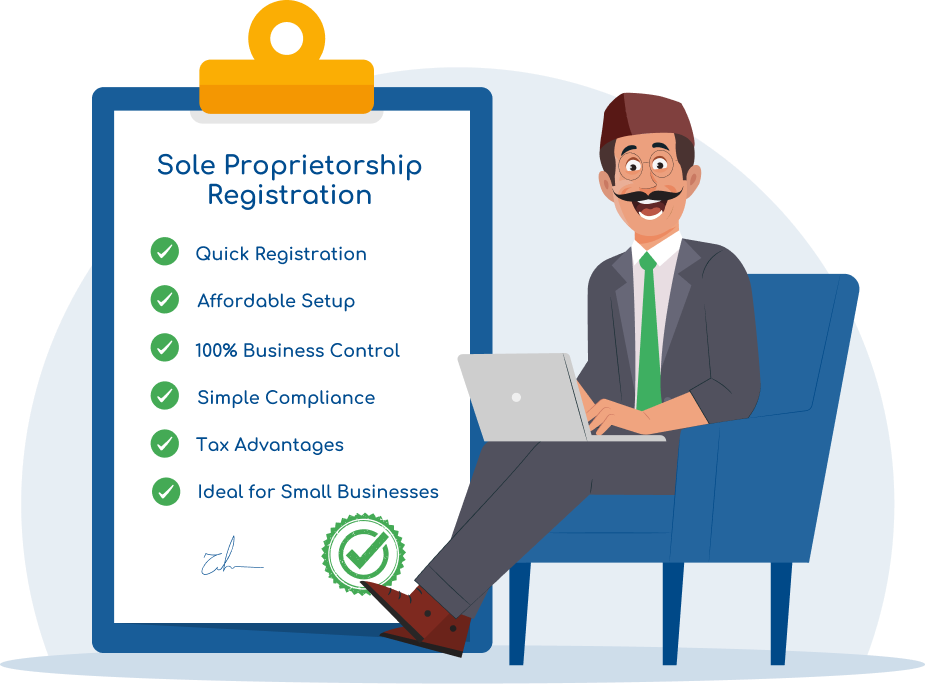
Small business owners often choose proprietorship because of its simplicity and affordability.
Key Benefits of Sole Proprietorship Registration
1. Easy to Start
The registration process is simple and requires minimal documentation.
2. Complete Control
The owner has full authority over business decisions without consulting partners or directors.
3. Low Compliance Burden
Compared to companies and LLPs, proprietorship firms have fewer legal compliances.
4. Cost-Effective
Registration and operational costs are significantly lower.
5. Easy Tax Filing
Income is taxed as individual income, making tax filing easier.
6. Quick Business Decisions
Since only one person manages the business, decisions can be made quickly.
7. Suitable for Small Businesses
Ideal for startups, freelancers, traders, consultants, and local businesses.
Is Sole Proprietorship Registration Mandatory?
There is no specific government-issued certificate for a sole proprietorship in India. However, the business can be legally established through relevant registrations and licenses such as:
PAN Card
Aadhaar Card
Udyam (MSME) Registration
GST Registration
Shop & Establishment License
Current Bank Account
Professional Tax Registration (where applicable)
These registrations collectively serve as proof of proprietorship.
Documents Required for Sole Proprietorship Registration
To register a sole proprietorship, the following documents are generally required:
Identity Proof
PAN Card
Aadhaar Card
Voter ID
Passport
Driving License
Address Proof
Electricity Bill
Telephone Bill
Bank Statement
Rent Agreement
Property Tax Receipt
Business Proof
GST Registration Certificate
MSME Registration Certificate
Shop & Establishment License
Trade License
Bank Documents
Cancelled Cheque
Bank Statement
Passport Size Photograph
Recent photograph of the proprietor.
Step-by-Step Process for Sole Proprietorship Registration
Step 1: Obtain PAN and Aadhaar
The proprietor must possess valid PAN and Aadhaar numbers.
Step 2: Choose Business Name
Select a unique business name suitable for your products or services.
Step 3: Register Under MSME (Udyam)
Obtain Udyam Registration to avail various government benefits and schemes.
Step 4: Apply for GST Registration
GST registration is mandatory if turnover exceeds prescribed limits or if the business operates in specific sectors requiring GST compliance.
Step 5: Obtain Shop & Establishment License
Required for commercial establishments operating within municipal limits.
Step 6: Open Current Bank Account
A current account in the business name helps maintain financial transparency.
Step 7: Start Business Operations
After completing the above registrations, the business can commence operations legally.
GST Registration for Proprietorship Firms
GST registration may be mandatory if:
Annual turnover exceeds prescribed limits.
Selling through e-commerce platforms.
Interstate supply of goods or services.
Specific businesses notified under GST law.
Benefits of GST Registration
Legal compliance
Input tax credit benefits
Increased business credibility
Easy expansion across India
MSME Registration Benefits for Proprietorship Firms
MSME registration provides several benefits:
Easy access to business loans
Government subsidies
Priority sector lending
Protection against delayed payments
Participation in government tenders
Lower interest rates on loans
Taxation of Sole Proprietorship Firms
A sole proprietorship does not file a separate income tax return.
The proprietor reports business income in their personal Income Tax Return (ITR).
Tax liability depends on:
Total business income
Individual tax slab
Applicable deductions and exemptions
The proprietor may also need to comply with:
GST Returns
TDS Compliance
Professional Tax (where applicable)
Compliance Requirements
Although compliance is minimal, proprietorship businesses should maintain:
Books of Accounts
GST Records
Sales and Purchase Registers
Tax Invoices
Bank Statements
Timely filing of returns helps avoid penalties and improves business credibility.
Sole Proprietorship vs Private Limited Company
| Particulars | Sole Proprietorship | Private Limited Company |
|---|---|---|
| Ownership | Single Owner | Multiple Shareholders |
| Registration Cost | Low | Higher |
| Compliance | Minimal | High |
| Legal Identity | Not Separate | Separate Entity |
| Funding Options | Limited | Better |
| Decision Making | Quick | Structured |
For small businesses and startups with limited investment, proprietorship remains an ideal choice.
Who Should Register a Sole Proprietorship?
This business structure is ideal for:
Freelancers
Consultants
Traders
Retail Shop Owners
Service Providers
Digital Marketers
Online Sellers
Small Manufacturers
Startup Entrepreneurs
Home-Based Businesses
Why Choose ProMunim for Sole Proprietorship Registration?
At ProMunim of India, we provide end-to-end assistance for Sole Proprietorship Registration across India.
Our Services Include:
Business Registration Consultation
Udyam (MSME) Registration
GST Registration
Shop & Establishment License
Current Account Assistance
Tax & Compliance Support
Accounting and Bookkeeping Services
Our experienced professionals ensure a smooth, hassle-free, and compliant business registration process.
Conclusion
A Sole Proprietorship is one of the easiest and most affordable ways to start a business in India. With minimal compliance requirements, complete ownership control, and quick registration procedures, it remains the preferred choice for small business owners, traders, freelancers, and consultants.
If you are planning to start your business, obtaining the right registrations and compliances from the beginning is essential for long-term growth and credibility.
ProMunim of India can help you register your proprietorship firm quickly and efficiently while ensuring complete legal compliance.
Get Started Today
Contact ProMunim of India for professional assistance with Sole Proprietorship Registration, GST Registration, MSME Registration, Accounting, Taxation, and Compliance Services.
FAQs
1. Is Sole Proprietorship Registration mandatory in India?
There is no separate government registration certificate, but GST, MSME, and other licenses serve as proof of proprietorship.
2. How much does Sole Proprietorship Registration cost?
The cost depends on the registrations and licenses required for your business activities.
3. Can a Sole Proprietorship have employees?
Yes, a proprietorship firm can hire employees.
4. Is GST mandatory for proprietorship firms?
GST is mandatory only under specified conditions and turnover limits.
5. Can a proprietorship be converted into a Private Limited Company later?
Yes, the business structure can be upgraded as the business grows.
6. Is MSME Registration compulsory?
No, but it is highly recommended because of the benefits available to small businesses.
7. Can I open a current account in the name of my proprietorship?
Yes, banks generally require GST, MSME, or Shop Act registration as business proof.
8. Which business structure is best for small businesses?
For small-scale operations, freelancers, traders, and consultants, Sole Proprietorship is often the most practical option.
Frequently Asked Questions
No FAQs found.